Arabic perfume skips the alcohol-and-water base most Western fragrances use. Oud, amber, musk, these are thick, heavy ingredients, and that’s why a good Arabian oil is still on your skin at 9 pm when a department-store spray faded by lunch.
People have been blending scents like this across the Middle East for thousands of years, and it was never just about smelling nice. Offering someone a fragrance or wearing one to greet a guest says something about respect. That part hasn’t really changed.
More people outside the region are trying them now, partly out of boredom with the same “clean, linen, citrus” fragrances everyone’s worn for a decade, partly because of TikTok; a lot of people hear about a brand like Ajmal or Rasasi from a video before they ever see it on a shelf. And once you smell one of these next to a $150 designer bottle, the price gap gets hard to justify.
What follows: where these fragrances actually come from, what goes into them, and which brands are worth buying, split out for women, men, and the unisex blends that don’t bother with the distinction, plus a few tips at the end on picking a bottle and making it last through the day.
Table of contents
- What Is Arabic Perfume?
- What Makes Arabic Perfumes Different?
- Why Are Arabic Perfumes Becoming So Popular?
- The History of Arabic Perfumery
- The Art of Perfume in Middle Eastern Culture
- Why Arabic Perfumes Last Longer
- Common Notes Found in Arabic Perfume
- Best Arabic Perfume Brands
- Best Arabic Perfume for Women
- Best Arabic Perfume for Men
- Best Unisex Arabic Perfume
- How to Choose an Arabic perfume
- How to Make Arabic perfume Last Longer
- Arabic perfume vs French Perfume
- Frequently Asked Questions
- Final Thoughts
What Is Arabic Perfume?
Arabic perfume, loosely, is fragrance made in the Gulf or styled after it: oud, amber, musk, rose, saffron, at oil concentrations that make most European eau de toilettes look watered down. It smells heavy, projects across a room, and is still clinging to your shirt collar the next day.
There’s no rulebook, though. Lattafa, Afnan, Armaf, Swiss Arabian, the big names are UAE or Saudi-based, sure, but at this point, brands with zero connection to the Gulf have borrowed and remixed the same DNA. Calling it “Arabic perfume” is more a shorthand for a smell than a claim about where the bottle was filled.
What Makes Arabic Perfumes Different?
A few things set these fragrances apart from what you’d find at a typical department store counter.
Rich ingredients.
Oud, amber, saffron, and musk aren’t cheap raw materials, and Arabic perfumers lean into them heavily instead of diluting them into the background. You notice these notes, not just sense them.
High perfume oil concentration.
Most Arabic perfumes sit closer to extrait de parfum or attar strength, 20-30% oil, sometimes more, where a standard eau de parfum is usually 10-15%. That concentration difference alone explains most of the longevity.
The other piece is technique. A lot of these houses are still working the way attar and bakhoor makers always have: oil-based extraction, long ageing, blending by feel more than by formula. If you’re curious how oud itself is actually produced, we’ve written a full guide on that.
Long-lasting performance.
Eight, ten, sometimes twelve-plus hours on skin isn’t unusual. That’s not marketing copy, it’s a direct result of the oil concentration and the dense, resinous base notes these perfumes are built on.
Luxury presentation.
Heavy glass bottles, gold accents, elaborate boxes. Even budget-friendly bottles from brands like Lattafa tend to look far more expensive than their price tag suggests.
Why Are Arabic Perfumes Becoming So Popular?
A decade ago, most people outside the Gulf had never heard of Lattafa or Rasasi. Now those names show up constantly in fragrance forums, YouTube reviews, and TikTok hauls. A few things are driving that.
Better value.
A $40-60 bottle of Arabic perfume routinely outperforms a $150+ designer fragrance in both longevity and projection. Once people notice that, it’s hard to go back.
Strong performance.
Fragrance fans obsess over “longevity” and “sillage” (how far a scent projects). Arabic perfumes tend to win on both, which matters a lot to people who want to spray once in the morning and still smell it at 8 PM.
Social media popularity.
TikTok’s fragrance community treats these bottles like hidden treasure. A single viral video comparing Lattafa Yara to YSL Libre can push a $35 bottle to sell out within days.
Luxury scents at affordable prices.
Many of these perfumes are built with the same note families as niche and designer houses, oud, amber, saffron, without the branding markup. For a lot of buyers, that’s the whole appeal.
The History of Arabic Perfumery
Ancient Origins
Perfume in Arabia isn’t some recent thing; people there were burning and trading frankincense and myrrh thousands of years ago, moving it up nearly 2,000 miles of caravan routes from southern Arabia and the Horn of Africa into Egypt, Mesopotamia, and eventually Rome.
Temples burned the stuff. Embalmers used it. It got traded like hard currency, and whole cities, Petra, Ma’rib, got rich just by sitting on the routes it passed through. A caravan run could eat up months, and the cargo was worth enough that people rode armed guard the entire way.
By the time Islamic civilization hit its stride, perfume wasn’t riding along on camels anymore; it had become its own craft. Perfumers in Baghdad and Damascus, later across the Gulf, kept pushing distillation further than anyone had managed before. Al-Kindi reportedly wrote one of the earliest texts on perfume chemistry, and historians tend to credit chemists like him with refining a process that eventually gave the world rosewater, and much later, alcohol-based perfume. I’d guess that’s a big part of why the tradition never really died out here the way it did elsewhere, the knowledge just kept getting passed down instead of lost.
The Art of Perfume in Middle Eastern Culture
Scent in the Gulf isn’t just personal grooming. It’s baked into daily life in a way that’s hard to overstate if you didn’t grow up around it.
Hospitality.
Offering a guest bakhoor (incense) or a dab of oud oil is a standard part of welcoming someone into a home across much of the Gulf. It’s a gesture, not an afterthought, often paired with Arabic coffee and dates as part of the same ritual, and passing on the incense burner is sometimes treated as a subtle cue that a visit is coming to a close.
Daily rituals.
Many households burn incense every day, not just for special occasions. Clothes, hair, and living spaces routinely carry that scent as a matter of course, to the point where a specific household’s bakhoor blend can become something close to a personal signature.
Religious traditions.
Perfume and incense show up throughout Islamic tradition. The Prophet Muhammad is widely reported to have loved fragrance, and a clean, pleasant scent is generally encouraged as part of personal presentation, including before Friday prayers.
Weddings.
Gulf weddings often involve elaborate scenting rituals, from bakhoor burned throughout the venue to oud oil applied to the bride and groom, and guests are frequently sent home with a small perfume or incense gift as a keepsake of the occasion.
Special occasions.
Eid, family gatherings, welcoming a new baby, nearly every major life event comes with its own scent tradition attached, and gifting perfume (rather than just wearing it) is itself a well-established custom.
Why Arabic Perfumes Last Longer
If you’ve ever sprayed a designer cologne and had it fade by lunch, then tried an Arabic perfume and still smelled it at dinner, you already know this isn’t just marketing. A few concrete factors explain it.
Higher oil concentration.
This is the big one. More fragrance oil per bottle means more scent molecules on your skin to begin with, which directly translates to longer wear.
Natural resins.
Ingredients like oud, amber, and frankincense are naturally heavy and slow to evaporate. They anchor a fragrance in a way that lighter citrus or aquatic notes simply can’t.
Dense base notes.
Arabic perfumes tend to be built bottom-up, with a thick, resinous base that carries the scent for hours rather than a light base that fades once the top notes burn off.
Layered compositions.
Instead of a simple top-middle-base structure, many of these fragrances layer multiple resins and woods together, so as one note fades, another is still holding on underneath it.
| Arabic Perfume | Designer Perfume | |
|---|---|---|
| Oil concentration | High (often 20-30%+) | Lower (typically 10-15%) |
| Average longevity | 8-12+ hours | 4-8 hours |
| Projection | Strong | Moderate |
| Dry-down | Rich, resinous | Lighter, often fades fast |
Common Notes Found in Arabic Perfume
Learning these notes is the fastest way to start picking perfumes you’ll actually like, instead of guessing from a bottle name.
Oud
Oud comes from agarwood, wood from a specific tree that gets infected by mould and starts pumping out a dark, fragrant resin to defend itself. Only the infected sections actually contain oud; the rest of the tree is just wood, which is a big part of why the real stuff has always been so expensive.
In perfume, it smells dark and woody, with that animalic, slightly dirty edge that oud people either love or can’t get past. Smoky, sometimes medicinal, occasionally sweet, and it really comes down to where the wood grew and how it got distilled. Cambodian oud leans sweet. Indian and Malaysian ouds go darker, more barnyard, more “is that a good smell or not.”
It’s not trying to be liked by everyone. That’s kind of the point of wearing it.
Best for: Evening wear, winter, anyone who wants a fragrance with real presence.
Examples: Lattafa Oud Mood, Afnan Oud Al Ta’if, Ajmal Oud Rose.
Want the deeper dive? Read our full guide on what oud is and how it’s made, and browse our roundup of the best oud perfumes for specific bottle picks.
Amber
Amber in perfumery has nothing to do with fossilized tree sap, despite the name. It’s mostly labdanum and benzoin — sometimes with a bit of vanilla or musk mixed in, depending on the perfumer.
Honestly, it’s one of my favourite notes in Arabic perfumery. Warm, golden, a little sweet in that vanilla-ish way. It’s the reason a $30 bottle can smell like it costs ten times that.
You rarely find it standing on its own, though. Amber usually works in the background, propping up the rest of the composition instead of being the star. Which is probably why it shows up next to oud so often — almost as much as rose does.
Musk
Musk is that “clean skin” warmth sitting underneath a lot of Arabic perfumes. Used to come from a gland in the musk deer, which is a strange thing to sit with once you know it. Everything sold commercially now is synthetic; no animal is involved anywhere in the process.
The job hasn’t changed. It rounds off whatever’s too sharp, pulls the scent in close to skin instead of letting it sit in the air, and it’s usually the last thing standing after the top and heart notes burn off, sometimes hours later. You know that faint trace on a pillowcase or a scarf, long after whoever was wearing it has gone? That’s Musk, still doing its thing quietly in the background.
Rose
Taif rose is everywhere in this kind of perfumery. Grown in the mountains around Taif, Saudi Arabia, it’s fruitier and messier than the Bulgarian or Turkish rose most people know, less “clean floral,” more like rose with jam and spice stirred in. I’ve heard perfumers talk about it almost like a wine appellation, like the mountain air itself does something to the petals.
It’s almost always paired with oud. Rose-oud is basically its own genre at this point, and the pairing makes sense the second you smell it: oud by itself can be smoky, almost medicinal, sometimes a bit much. Rose by itself can slide into soap-bar territory. Put them together, and the rose takes the edge off the oud, while the oud stops the rose from smelling like something your grandmother would wear.
Vanilla
Vanilla is doing a lot of work in Arabic perfumery right now, especially in anything built for cooler weather or evening wear, it’s the thing that makes a scent feel like dessert without actually smelling like candy. By itself, though, vanilla can be kind of boring. One-note. It needs something to push against. That’s what cinnamon and cardamom do in something like Khamrah; suddenly, it’s not “sweet” anymore, it’s warm baked goods, like something just came out of the oven.
Saffron
Saffron brings a spicy, slightly leathery, almost bready warmth to a fragrance’s opening. It’s one of the most expensive spices in the world by weight, and its presence in a perfume’s note list often signals a more premium blend, or at least a brand trying to signal one. In practice, saffron rarely smells the way it does in a spice jar — in perfumery, it reads more like a dry, faintly medicinal spice than the earthy flavour you’d get in a saffron rice dish.
Sandalwood
Sandalwood’s the soft one, creamy, woody, none of the sharp edges you get with something like oud. The Mysore stuff from India is the classic reference point, though good luck finding much of it these days; overharvesting means it’s heavily regulated now, and most of what’s on shelves is Australian or synthetic. What I like about it is how unfussy it is. Perfumers reach for it constantly as a base note just to calm down harsher ingredients — saffron, oud, whatever’s making the top notes feel abrasive. So if something smells a little rough out of the bottle but mellows into this warm, creamy thing after an hour on skin, that’s sandalwood quietly doing its job underneath.
Incense
Incense notes — smoky, a bit resinous, usually frankincense at the base — smell like old trade routes and old temples. It’s not a note that sits quietly in a blend. Light it, and it takes over the room, which is why perfumes built around incense tend to skew bold instead of polite. I don’t know how else to describe it except that it smells older than it is.
Patchouli
Earthy and a little damp-smelling in the best way, patchouli adds depth and grounds sweeter compositions so they don’t tip over into cloying. It’s a note that divides people — some find it grounding and rich, others find it too heavy — but in small doses, it’s what keeps an otherwise candy-sweet fragrance from feeling one-dimensional.
Leather
Sharp, slightly smoky, sometimes a little animalic, leather notes show up in the more masculine-leaning side of Arabic perfumery, often layered with oud or saffron for a scent with real edge. Modern leather notes are built synthetically to mimic the smell of tanned hide, birch tar, or suede, and they’re especially common in bottles designed for cold weather and evening wear.
Best Arabic Perfume Brands
A handful of houses dominate this space, and each one has its own personality. Here’s a rundown of the ones worth actually knowing.
Lattafa
Lattafa is arguably the brand that introduced most Western buyers to Arabic perfumery in the first place, largely thanks to a string of viral TikTok comparisons. Saudi-founded, mass-market in the best way, genuinely wearable scents at prices that make experimenting easy.
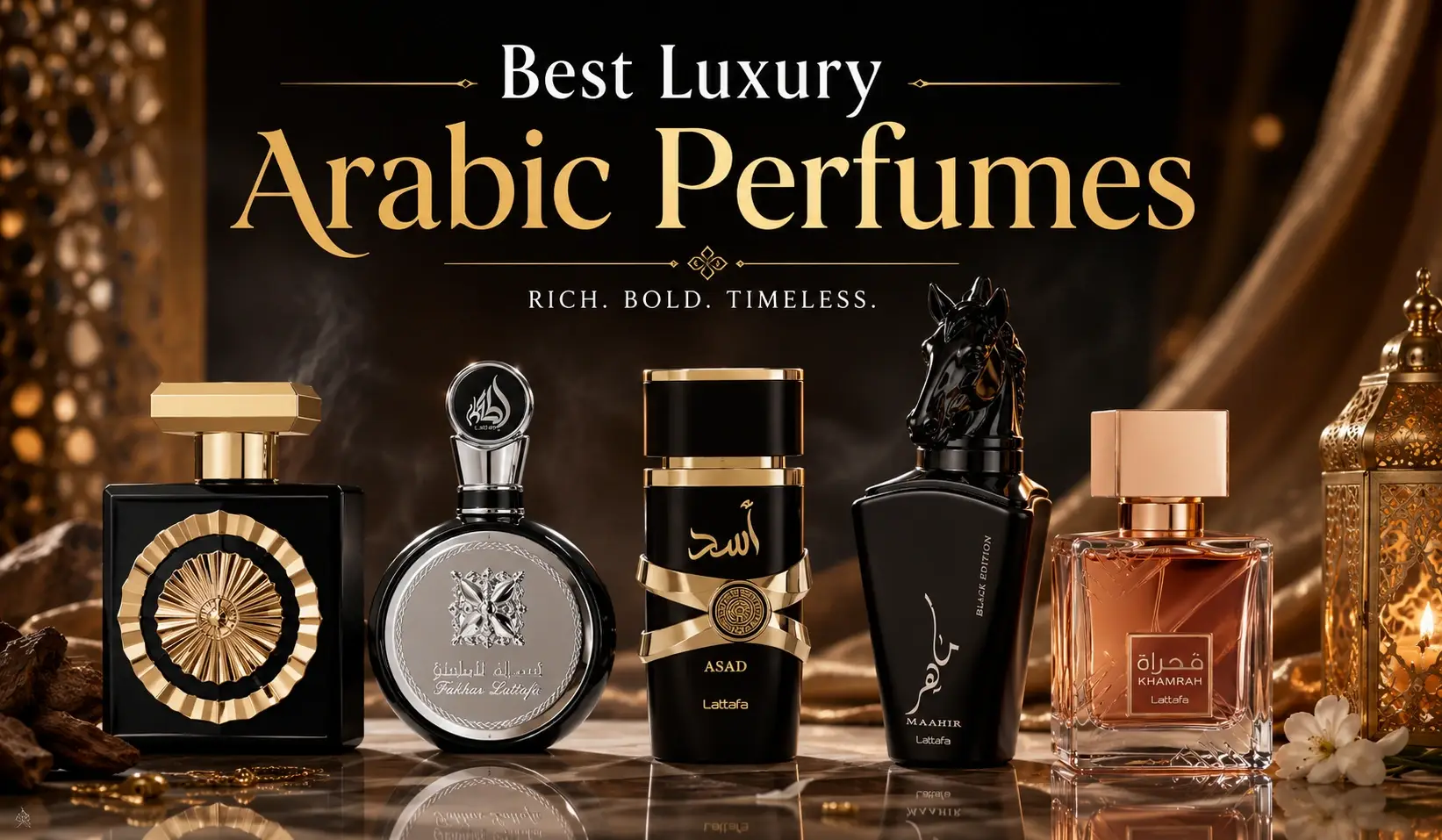
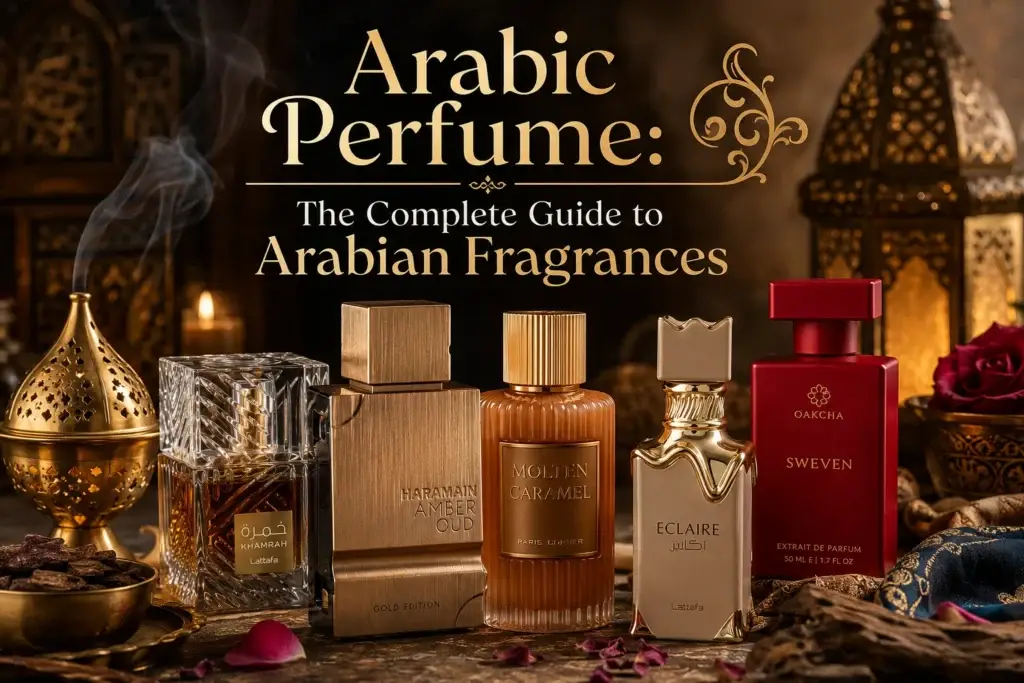
Popular perfumes: Yara, Khamrah, Eclaire, Asad.
See our full breakdown in the Best Lattafa perfumes guide.
Maison Alhambra
A Spanish-Arabic hybrid house known for closely-inspired takes on niche and designer fragrances, often at a steep discount. Quality varies bottle to bottle; some releases are near dead ringers for their inspiration, others fall a bit short, but when they land, the value is hard to beat, and the catalogue is large enough that there’s usually a version of whatever niche scent you’re chasing.
see our full breakdown in the Ultimate Guide to Maison Alhambra: Luxury Scents on a Budget
Afnan
Afnan leans into big, bold, oud-heavy compositions with excellent bottle design that often outshines fragrances costing three or four times as much. Their Supremacy line in particular has built a loyal following for being loud, long-lasting, and reliably good, and the brand has become one of the more consistent names for buyers who want something photogenic on a shelf as much as something that smells great.
Armaf
Armaf sits at a slightly higher price point than Lattafa but still well under designer pricing, with a catalogue that includes some of the most talked-about “dupe” scents in the fragrance community, like Club de Nuit Intense Man, widely regarded as one of the closest affordable takes on Creed Aventus on the market. Armaf also puts real effort into packaging, which helps the brand feel a notch more premium than its price point suggests.
Swiss Arabian
One of the older, more established names, blending European perfumery techniques with Gulf ingredients since the 1980s. Consistent quality, slightly more classic in style than the newer, trend-chasing brands.
Rasasi
A Saudi Arabian house particularly known for Hawas, one of the most consistently recommended men’s fragrances in the Arabic perfume space, woody, spicy, and well-balanced.
Al Haramain
Al Haramain covers a huge range, from budget attars to more premium oud-focused releases, and is especially popular for traditional, less Westernised blends.
Paris Corner
A slightly under-the-radar brand that punches above its price point, particularly for fruity-floral and gourmand compositions aimed at newer perfume wearers.
Ajmal
A UAE-based heritage brand with a strong reputation for high-quality oud and rose compositions, sitting closer to the premium end of the Arabic perfume market.
Best Arabic Perfume for Women
For the full ranked list with pricing and where to buy, see our complete guide to the Best Arabic perfumes for women. Here are five standouts to start with.
1. Lattafa Yara Notes:
Vanilla, tuberose, sandalwood, orange blossom. Longevity: 8-10 hours. Best season: Fall/winter. A warm, sweet vanilla-floral that’s earned constant comparisons to YSL Libre — softer and more approachable, with excellent staying power for the price.
2. Lattafa Khamrah Notes:
Cinnamon, dates, tonka, vanilla. Longevity: 10+ hours. Best season: Winter. Technically unisex, but hugely popular with women for its warm, spiced dessert character. One of the most talked-about bottles of the last few years, for good reason.
3. Maison Alhambra Ard Al Zaafaran
Notes: Saffron, rose, oud. Longevity: 8-10 hours. Best season: Fall/winter. A rich, spicy oud-rose blend that reads more expensive than its price tag would suggest.
4. Ajmal Amber Wood
Notes: Amber, sandalwood, patchouli. Longevity: 8+ hours. Best season: Year-round. A warm, cozy amber-wood blend with excellent balance — sweet without being overpowering.
5. Afnan 9 pm Woman
Notes: Vanilla, praline, sandalwood. Longevity: 8-10 hours. Best season: Fall/winter. A gourmand crowd-pleaser, easy to wear and consistently well-reviewed for the price.
6. Armaf Club de Nuit Woman Intense
Notes: Black currant, apple, rose, patchouli. Longevity: 8+ hours. Best season: Year-round. A fruity-floral with real backbone, often mentioned in the same breath as far pricier niche florals.
7. Al Haramain L’Aventure
Notes: Apple, vanilla, caramel, musk. Longevity: 8-10 hours. Best season: Fall/winter. Sweet and comforting without being overly simple, thanks to a musky base that keeps it from feeling flat.
Best Arabic Perfume for Men
See the extended ranked list in our guide to the Best Arabic perfumes for men. Here are five to know.
1. Rasasi Hawas
Notes: Bergamot, lavender, cedarwood, amber. Longevity: 8-10 hours. Best season: Spring/fall. Consistently recommended as one of the best all-around men’s fragrances in this category, with a fresh opening and a warm woody base.
2. Lattafa Asad
Notes: Cinnamon, vanilla, tobacco, oud. Longevity: 10+ hours. Best season: Winter. Bold, sweet, and smoky, frequently compared to niche tobacco-vanilla fragrances at a fraction of the cost.
3. Armaf Club de Nuit Intense Man
Notes: Pineapple, birch, blackcurrant, musk. Longevity: 8-10 hours. Best season: Year-round. The most famous “dupe” fragrance in the entire Arabic perfume space, widely compared to Creed Aventus.
4. Afnan Supremacy Silver
Notes: Bergamot, apple, cardamom, oud. Longevity: 8+ hours. Best season: Spring/summer. Fresher and more citrus-forward than most Afnan releases, with just enough oud to keep it interesting.
5. Al Haramain Amber Oud Gold Edition
Notes: Amber, oud, vanilla. Longevity: 10+ hours. Best season: Fall/winter. A rich, sweet, unapologetically loud amber-oud blend built for cold weather.
6. Ajmal Ehsaas Him
Notes: bergamot, spices, oud, musk. Longevity: 8-10 hours. Best season: Fall/winter. A well-rounded spicy-woody scent that leans premium without straying into “too niche to wear casually.”
7. Swiss Arabian Shaghaf Oud
Notes: Oud, saffron, rose. Longevity: 8+ hours. Best season: Winter. Dark and resinous with just enough rose to keep it from feeling harsh, built for someone who wants a serious oud without going full attar.
Best Unisex Arabic Perfume
Plenty of the biggest names in this category don’t sit neatly in a “men’s” or “women’s” box at all.
Oud Mood — Deep, woody, resinous, with a smoky character that works equally well on any wearer.
Khamrah — Spiced dates and tonka bean, warm enough for winter and popular across genders.
Amber Oud Gold — Sweet, resinous amber layered over oud, built for cold-weather wear regardless of who’s wearing it.
Shaghaf Oud Tonka by Swiss Arabian — A creamy, tonka-heavy oud blend that’s become one of the brand’s most-praised releases for its balance and wearability.
How to Choose an Arabic perfume
With this many options, narrowing down where to start matters. There’s no single “right” bottle — the best approach is usually to pick one variable that matters most to you (a note you already love, an event you’re shopping for, or a budget ceiling) and let that filter the list before you start reading individual reviews. Here’s a simple way to think it through.
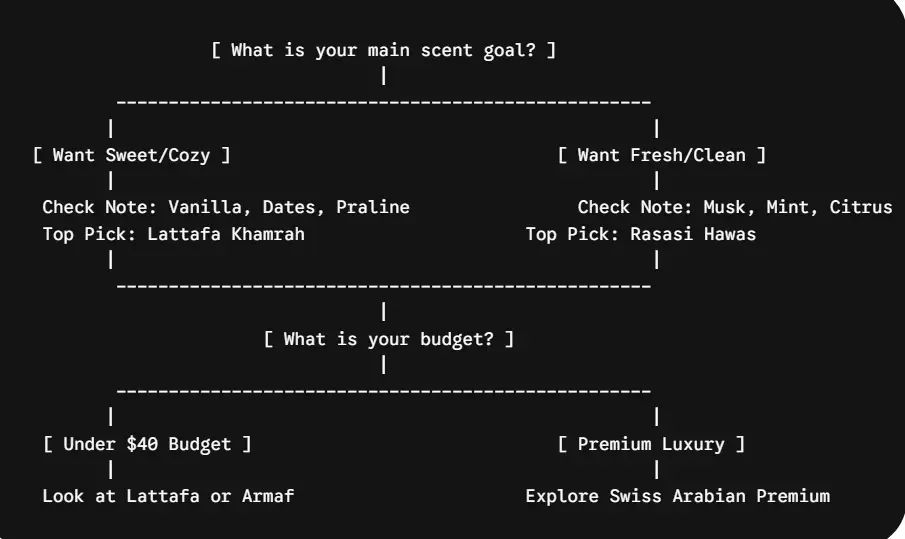
Choose by Notes
- Sweet: Khamrah, Yara, Asad
- Woody: Oud Mood, Hawas, Amber Wood
- Floral: Yara, Afnan, 9 pm Woman
- Vanilla: Yara, Asad, 9 pm Woman
- Gourmand: Khamrah, Afnan, 9 pm Woman
- Citrus: Club de Nuit Intense Man, Supremacy Silver
- Leather: Asad, select Afnan Supremacy releases
Choose by Occasion
- Office: Something lighter with moderate projection — Supremacy Silver, Club de Nuit Intense Man
- Wedding: A statement scent — Amber Oud Gold, Khamrah
- Every day: Balanced and versatile — Hawas, Yara
- Date night: Warm and sensual — Asad, Oud Mood
- Winter: Rich and resinous — Khamrah, Amber Oud Gold
- Summer: Lighter, fresher builds — Supremacy Silver, Club de Nuit Intense Man
Choose by Budget
- Under $30: Many Lattafa and Al Haramain releases
- $30-60: Most Lattafa, Armaf, and Afnan bottles
- $60-100: Swiss Arabian, select Ajmal and Rasasi releases
- Luxury ($100+): Premium Ajmal collections, speciality oud oils and attars
How to Make Arabic perfume Last Longer
Even a strong fragrance can underperform if it’s not applied correctly. A few habits make a real difference.
Moisturize skin.
Dry skin doesn’t hold fragrance well. Apply an unscented lotion before spraying, especially in colder months.
Pulse points.
Wrists, neck, and behind the ears run warmer, which helps the fragrance diffuse throughout the day.
Layering.
Pair your perfume with a matching scented body wash or lotion if the brand offers one — it builds a stronger base for the fragrance to sit on top of.
Clothing.
A light spray on clothing (test first for staining) holds scent longer than skin alone, since fabric doesn’t process fragrance the way skin does.
Storage.
Keep bottles away from direct sunlight and heat. Both accelerate the breakdown of fragrance oils, and a poorly stored bottle will noticeably underperform a well-stored one within months.
Arabic perfume vs French Perfume
| Arabic Perfume | French Perfume | |
|---|---|---|
| Performance | Very strong, long-lasting | Moderate, often shorter-lived |
| Projection | Bold, fills a room | Typically more restrained |
| Ingredients | Oud, amber, resins, dense bases | Wider variety, often lighter florals/citrus |
| Price | Generally more affordable | Often significantly higher |
| Style | Warm, rich, statement-making | Elegant, refined, subtle |
| Best choice for | Bold personalities, cold weather, evening wear | Office settings, understated daily wear |
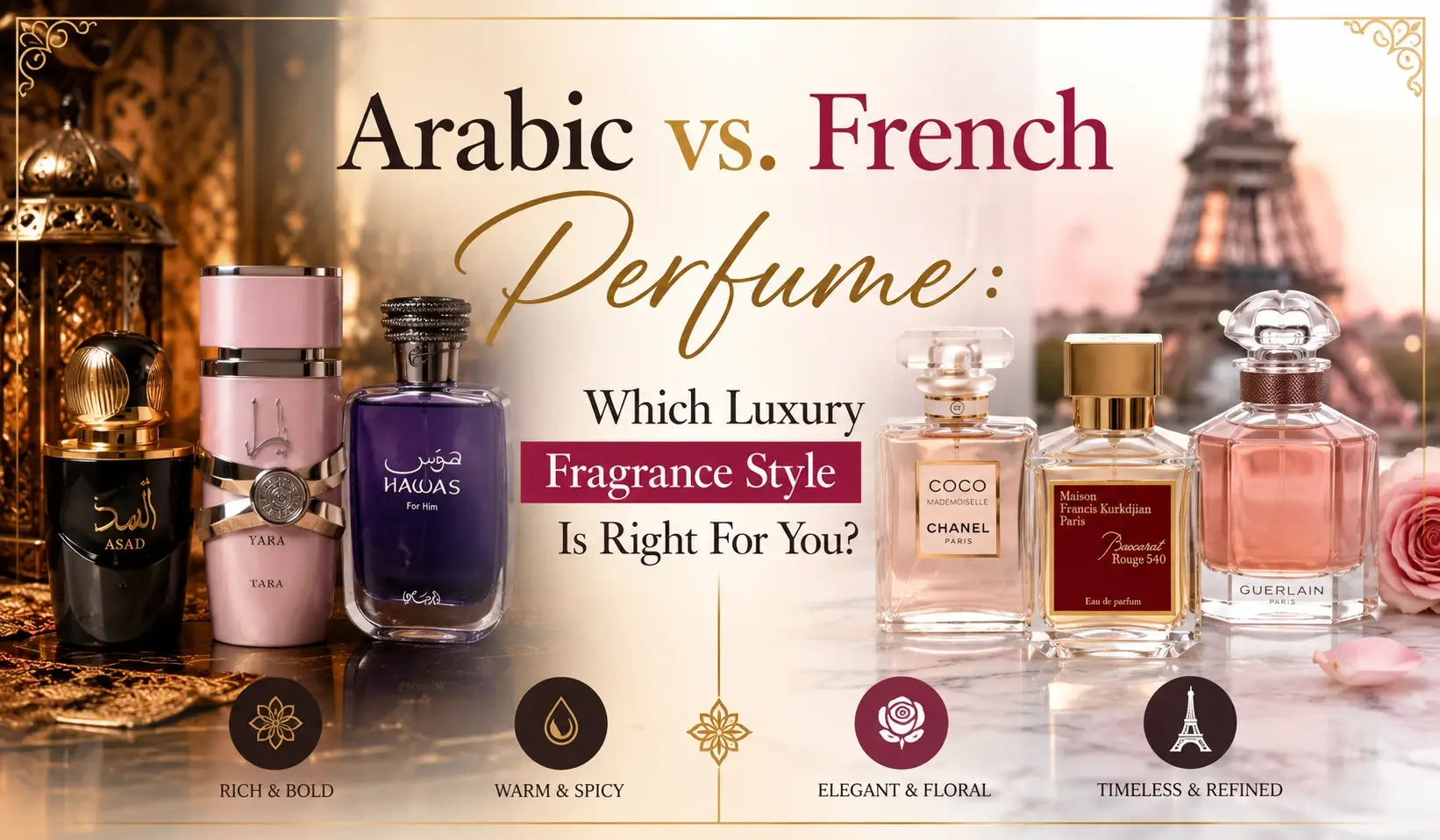
Neither style is objectively “better” — it comes down to what you want a fragrance to do. If you want to be remembered in a room, Arabic perfumery generally wins. If you want something quieter that blends into a professional setting, French perfumery still has an edge. For a deeper comparison of specific bottles across both styles, see our full Arabic vs. French perfume breakdown.
Frequently Asked Questions
Arabic perfume refers to fragrances made in or in the style of the Gulf region, built around ingredients such as oud, amber, musk, and rose, typically with a much higher oil concentration than Western designer fragrances.
Yes. Most last 8-12+ hours on skin, largely due to their high oil concentration and dense, resinous base notes.
Generally, yes, in both projection and longevity. That comes from the higher concentration of fragrance oil used in most Arabic perfume formulations.
Oud smells woody, smoky, and a little animalic, with notes that can range from sweet to slightly medicinal depending on how the agarwood was processed.
It depends entirely on personal taste, but Lattafa Khamrah, Rasasi Hawas, and Armaf Club de Nuit Intense Man are consistently among the most recommended across the fragrance community.
Absolutely. Brands like Lattafa and Ajmal produce extensive women’s and unisex lines, ranging from soft florals to bold oud-based scents.
Khamrah, Asad, and Amber Oud Gold Edition are all known for lasting 10+ hours on most skin types.
Yes, though it’s worth choosing lighter, fresher options like Club de Nuit Intense Man or Afnan Supremacy Silver rather than heavier oud-forward blends, which tend to suit colder weather better.
Many brands sell direct-to-consumer with less spending on celebrity endorsements and marketing campaigns than major designer houses, which keeps retail prices lower without necessarily lowering quality.
Buy directly from brand websites, authorized retailers, or established fragrance marketplaces. Be cautious of unusually low prices on third-party sites, which can signal counterfeit products.
Final Thoughts
Arabic perfumery brings something most Western fragrance houses simply don’t prioritize: real, unapologetic strength. High oil concentrations, resinous ingredients like oud and amber, and a long tradition of craftsmanship combine into fragrances that perform for hours and genuinely turn heads.
If you like bold, memorable scents, or you’re tired of reapplying a $150 bottle every few hours, this category is worth exploring. It works whether you’re a beginner looking for an affordable way to build a collection, or an experienced fragrance collector chasing a specific note like saffron or aged oud.
Ready to discover your perfect fragrance? Explore our in-depth reviews of popular Arabic perfumes like Lattafa Eclaire, Khamrah, Yara, and Amber Oud Gold, or browse our buying guides to find the ideal scent for your style and budget.